
Read the original research article here:
https://onlinelibrary.wiley.com/doi/full/10.1002/poi3.414
cited as: Kim, J., & Ahn, S. (2025). The platform policy matrix: Promotion and regulation. Policy & Internet, 17(1), e414.
Authors:
Junic Kim, School of Business, Konkuk University, South Korea
Editor:
Wenjia Tang, Media and Communications, University of Sydney, Australia
From ordering food, consuming news, to running businesses, digital platforms play a major role in everyday life. Such developments have caused governments to be hit with a difficult question. Should platforms be treated as a tool for valuable creations, or as powerful firms requiring stronger regulation?
That question is now more pressing than it has been before. Platforms can open markets, support small businesses, and accelerate digital innovation. But these platforms also gather vast amounts of data, affect the way users access markets, impose unfair conditions on smaller players, and act as gatekeepers across broader digital environments.
Policy debate often reduces this to a choice. One side supporting the idea that overly restricting will dampen innovation and national competitiveness. The other arguing that weak regulation enables harm towards consumers, workers, competitors, and the public’s ability to hold those truly responsible accountable. Both concerns matter, yet difficult to balance.
Our article, “The platform policy matrix: Promotion and regulation,” argues that platform policy should be about finding the middle ground. Governments do not simply choose between supporting digital companies and regulating them. In practice, they combine both approaches in different ways. The key being whether the middle ground matches the country’s platform economy.
The Platform Policy Matrix makes that clearer. It organises them in two groups: how far a government promotes innovation and how strongly it regulates platform behaviour. This produces four options that are not necessarily set in stone. Countries may favour one over the other, which would still differ as each chooses how far they promote innovation or how intensely they regulate platform behaviour.
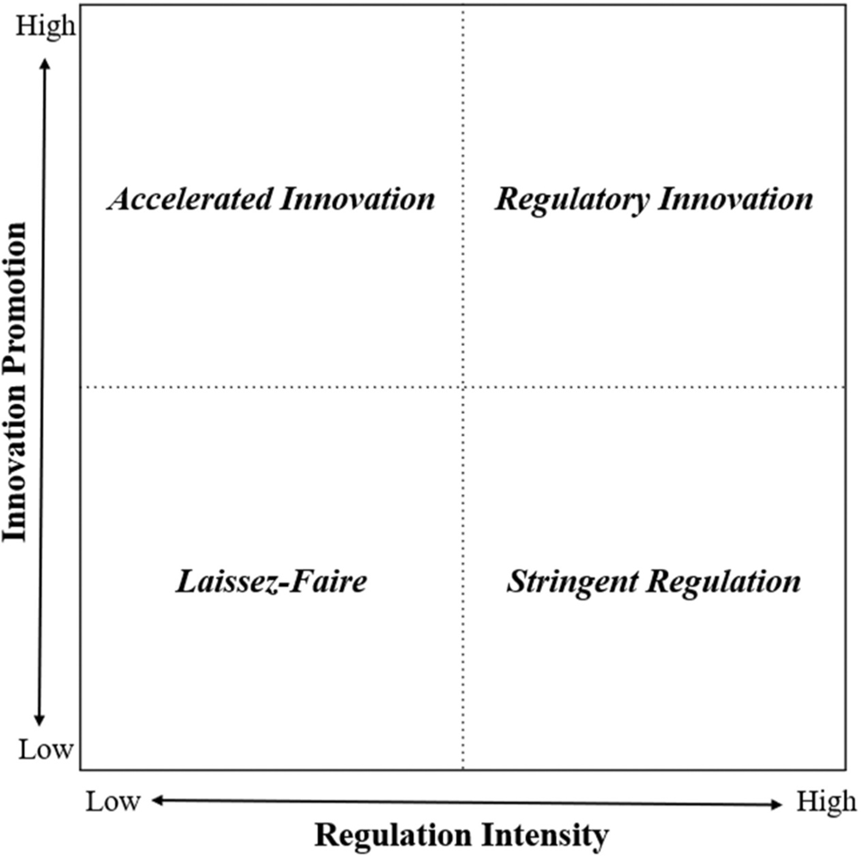
Some countries prioritise efficiency in growth and value adding creations, having more lenient rules to allow room for growth. Others move towards strict regulation, focusing more on consumer protection, competition, responsibility, and public accountability. Another route is regulatory innovation, where governments try to support platform growth while still maintaining meaningful oversight. A much more laid back approach in which both active encouragement and regulation remain limited.
This helps to explain why countries regulate platforms differently. The European Union has moved from rule-making to active enforcement through the Digital Markets Act and the Digital Services Act, designating firms such as Alphabet, Amazon, Apple, ByteDance, Meta, Microsoft, and Booking.com as digital “gatekeepers.” The United States has been more cautious: although app-store and platform competition bills continue to be proposed, it has not adopted an EU-style ex ante platform regulation regime. China combines strong antitrust oversight and state involvement with continued support for the “healthy development” of its platform economy. Korea and Japan have taken more balanced approaches, debating fairness, transparency, and competition rules while also seeking to support domestic platform firms such as Naver, Kakao, Rakuten, and LY.
The bigger takeaway is that good platform management needs to be context sensitive. A country with global platform giants faces a different policy challenge from a country attempting to grow domestic platforms. Where foreign gatekeepers dominate, governments need a different set of tools than those used in settings where local firms are strong. The same intervention may foster competition in one environment while limiting innovation elsewhere.
Having good platform management should therefore go beyond slogans. The question is not simply whether governments ought to regulate platforms or support them. The real challenge is creating a middle ground that keeps platforms innovative, competitive, accountable, and valuable to society.
Know more about our author:
Professor Junic Kim is Chair of the Department of Business Administration at Konkuk University. His research focuses on platform business, innovation, and AI strategy. Before entering academia, he worked in strategic planning at Samsung Electronics Headquarters. He is a Fellow of the Royal Society of Arts (FRSA) and serves as an advisor to Meta.